
Inside the city's Asian longhorned beetle zone
Tree Service in Worcester, MA
Tight lots, steep streets and wood that has to stay inside the regulated area.
- No-cost estimates at your property in Worcester and Central Massachusetts
- Quotes in writing, broken out per tree
- We settle what leaves the property before we start
A City of Hills, Maples and Narrow Side Yards
Tree Service in Worcester is shaped by three things you notice the first time you walk a job here: the hills, the spacing between houses, and the beetle quarantine. A silver maple behind a triple-decker on Vernon Hill may have a driveway on one side, a neighbor's porch on the other and wires overhead. We plan each removal and pruning job around that geometry, and around the rule that host wood from inside the regulated area cannot simply be trucked out of it.
Who owns the tree by the sidewalk?
The city's Department of Parks, Recreation and Cemetery cares for and removes city-owned trees, which generally means the trees in the sidewalk strip next to the street and on city property. Trees on private land and private streets belong to the owner. If you are not sure which side of that line a tree falls on, the city asks residents to call Forestry at 508-929-1300, and a street tree you think is unsafe can be reported through 311 for a safety inspection. We will not cut a public shade tree without the tree warden's written approval, which Worcester's tree ordinance requires.
What the beetle program means for your wood
Worcester has been inside the Asian longhorned beetle regulated area since the insect was found in the city in 2008. Moving firewood, logs or other host wood out of the area is prohibited. The beetle favors maples (boxelder, Norway, red, silver and sugar), along with birch, elm, horse-chestnut, willow and Ohio buckeye. For a homeowner, that means a removal is usually chipped on site, and any wood you keep for your own fireplace stays in the city. The city notes that homeowners may burn wood from their own trees, but it should be checked for beetle signs first: round exit holes about the size of a pencil, oozing sap, and piles of coarse sawdust at branch unions.
A canopy that has changed
According to the city's Urban Forest Master Plan, Norway maple made up about 60% of Worcester's street trees in 2005 and about 28% in 2022, after thousands of host trees were removed during the beetle eradication. The same plan counts 23,137 street trees in 2022, up from 15,486 in 2005, thanks in part to the replanting effort that followed. Many backyards still hold old Norway and silver maples planted in the mid-1900s. Those trees are prone to weak, tight forks and heavy limbs over garages, and they tend to be what we prune and remove most often in the city.
Jobs we handle on city lots
- Sectional removal of maples and oaks wedged between houses, lowering pieces by rope instead of dropping them
- Crown cleaning to take deadwood out over roofs, porches and parked cars
- Clearance pruning away from the house, so limbs stop scraping siding and gutters
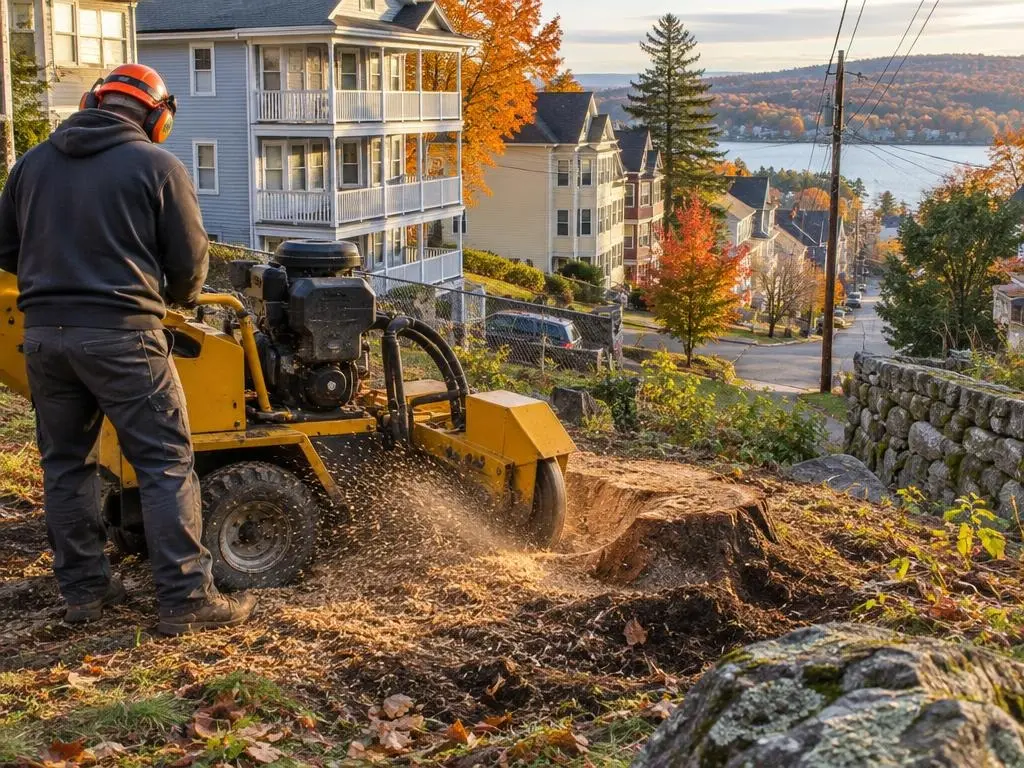
- Stump grinding where a backyard is being reclaimed for a garden or patio
- Storm work after wind or ice, when a limb is hung up or resting on a fence
- Chipping on site, so host wood never has to leave the regulated area
Steep driveways and hill streets
Worcester sits at about 479 feet of elevation, and the city is famous for claiming seven hills, though it has more than that. On streets that climb Bancroft, Belmont or Pakachoag Hill, setting up a chipper and keeping logs from rolling takes extra care. When we quote a hillside job, we note where the truck can safely park and how brush will be moved to it.
Getting a price
Call (508) 731-3691 or send the form with your address and a couple of photos. We walk the yard, point out which trees are public and which are yours, and leave a written estimate that spells out cleanup and wood handling. Get a free estimate
Worcester Tree Facts
- Sidewalk trees are city trees. Parks, Recreation and Cemetery maintains city-owned trees in the sidewalk strip and on city land; residents can call Forestry at 508-929-1300 to sort out ownership and request street tree inspections through 311.
- Still a regulated beetle area. As of the state's September 2026 update, the Asian longhorned beetle regulated area still covers the City of Worcester, along with Boylston, West Boylston and part of Auburn. Moving host wood or firewood out of it is prohibited.
- Norway maple's long decline. The Urban Forest Master Plan reports that Norway maple fell from about 60% of street trees in 2005 to 28% in 2022, while the street tree count rose from 15,486 to 23,137.
- Limb drop-off limits. The Millbury Street drop-off site takes limbs up to 8 inches in diameter and 8 feet long from Worcester residents, April through November. Stumps are not accepted at any city yard waste site.
- Public tree penalties. Worcester's public tree ordinance requires the tree warden's written approval to cut, trim or remove a public shade tree, and violations can be fined up to $300, with each day counted as a separate offense.
Worcester Questions
Can I take the logs from my maple to my camp in New Hampshire?
Not from inside Worcester. The city is part of the Asian longhorned beetle regulated area, and host wood and firewood may not be moved out of it. We chip brush on site, and you can keep inspected wood for use at home in the city.
The city tree in front of my house is dropping limbs. Can you prune it?
Not without the tree warden's written approval, because it is a public shade tree. Report it through 311 or call Forestry at 508-929-1300 so the city can inspect it. We are glad to handle any private trees on the same lot.
Can I get rid of branches myself instead of paying for haul-away?
Often, yes. Worcester residents can bring brush to the city's yard waste sites, and the Millbury Street site takes limbs up to 8 inches thick and 8 feet long from April through November. Stumps are not accepted, so grinding is usually the way to deal with those.
How do you take down a big tree between two triple-deckers?
Usually in sections. A climber or a lift works from the top down and lowers each piece on a rope so nothing lands on a roof or porch. When access is very tight, a crane is sometimes the safer option, and we will tell you if we think that is the case.
Free Estimates in Worcester, MA
Free written estimates anywhere in Worcester, from Greendale to Quinsigamond Village.
Tree Service Near Worcester
- Tree Service in Shrewsbury, MA
- Tree Service in Holden, MA
- Tree Service in Auburn, MA
- Tree Service in Leicester, MA
- Tree Service in Paxton, MA
- Tree Service in Boylston, MA
- Tree Service in West Boylston, MA
- Tree Service in Grafton, MA
- Tree Service in Millbury, MA
- Tree Service in Westborough, MA
- Tree Service in Northborough, MA
- Tree Service in Spencer, MA
- Tree Service in Sutton, MA
- Tree Service in Oxford, MA
- Tree Service in Rutland, MA
- Tree Service in Princeton, MA
- Tree Service in Sterling, MA
- Tree Service in Charlton, MA
- Tree Service in Northbridge, MA
- Tree Service in Clinton, MA
- Tree Service in Upton, MA
- Tree Service in Sturbridge, MA
- Tree Service in Webster, MA
- Tree Service in Southborough, MA